
By Amy Kuczynski, Communications Manager
Women’s rights have undoubtedly made significant strides over the years – real progress has been achieved. But the challenge isn’t over, particularly in housing, where women are often disproportionately impacted:

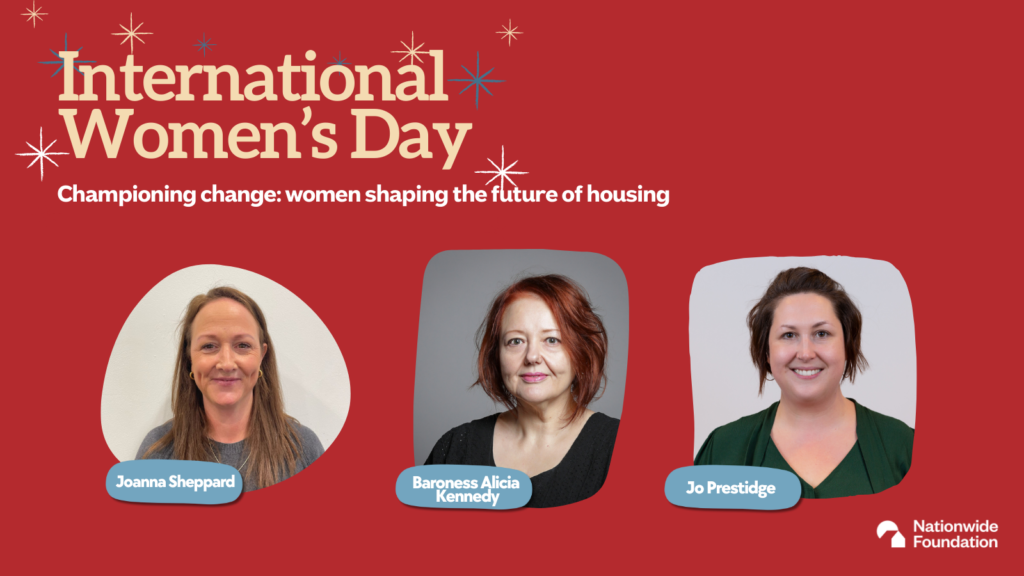
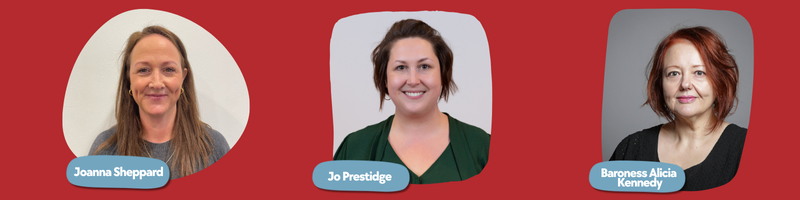
To mark International Women’s Day, I spoke with three remarkable women who are working to change the housing system for the better, for all: Joanna Sheppard, Operations Manager at the Nationwide Foundation, Jo Prestidge, Head of National Practice Development, at our funded partner Homeless Link and Baroness Alicia Kennedy, Trustee of the Nationwide Foundation.
What inspired you to work in housing, or the charity sector and how did you get started?
Joanna: “I wanted to work somewhere I could make a difference. Somewhere where I could transfer my skills into an organisation that was mission and purpose driven”
Jo: “I think that I have a very innate drive to want to help people who are more vulnerable and disadvantaged than me.” The majority of Jo’s impressive career has focused on homelessness services and support – a topic she’s been curious about since a young age.
Alicia has seen first-hand the impact poor-quality unaffordable housing has on communities, through her distinguished career in politics, and experience as a local councillor: “It brings it home, really when, as a councillor, you see how people live.”
How has being a woman shaped your career?
Joanna: “Empathy is not just a trait that women have, absolutely not, but I do think that empathetic, maternal nature has helped kind of propel me in the role.”
Jo agrees: “Women often inherently have high empathy and seek to build connection with others. There is consideration of relationships. These things have influenced the work I’ve done in homelessness.”
Across all three women, there’s a natural gravitation and ability to build strong connections with other women. For Joanna, this has been visible within the Nationwide Foundation: “People have come and gone slightly, but throughout the time I’ve been here, the women in this organisation have supported each other and I feel really strongly that we continue to do that as women.”
Similarly for Jo: “Women can really hold one another up and create space for each other. This is really important because we have really useful things to contribute and ways of working in collaboration, which create good, meaningful outcomes.”
Through Alicia’s experience she has observed “a lot of camaraderie in politics and in professional life – there’s a lot of support.” She adds, “When you get a strong team of women, or you have strong women around you, you are much better for it.”
Have you faced any specific professional challenges as a woman? If so, how have you overcome these?
Joanna: “Coming back to work after having a career break has been my biggest professional challenge.” This experience impacted her self-worth, particularly due to the stigma she faced from recruiters who wrongly presumed her career break meant she’d “lost pace”. This challenge, which Joanna and others have referred to as “identity shift”, profoundly affected her sense of self.
So, what was the solution? “Re-evaluating how you think of success.” Working at the Nationwide Foundation provided her with a sense of purpose and empowerment. “The rewards come from the fact that you feel empowered to give back… you start to see value in yourself in the role that you do because it’s got purpose.”
Jo: “I’ve found it more difficult the more senior I’ve got, I think, because I’ve had to step into my own power and authorise myself – which I don’t think, from a young age, many women were encouraged to do.” A significant challenge arose when Jo was told she was “too emotional to ever be a manager” and advised that to be able to progress “you can’t say you’re anxious or upset.” But, on reflection, Jo recognised that she felt these emotions because she was “frustrated about situations and felt quite powerless about them.” What she needed was to be “supported to navigate those emotions,” rather than criticised for having them.
Alicia acknowledged that politics is a very male dominated space, and misogyny exists across many professional environments. While she has not personally felt any specific challenges related to her gender, she feels “grateful every day that we never had social media.” Shockingly, many MPs and political figures have commented on the prevalence of misogyny and abuse aimed at them through social media, which for women, often includes sexualised language and personal insults.
Do you have any female role models or inspirational women who you’ve looked up to during your life or career?
Joanna was inspired by a senior leader in her previous role at the Football Association, who worked for 30 years to enable more girls to play football in a male-dominated industry. At an early stage of Joanna’s career, this colleague “never, ever wavered from what she believed”, making it “a privilege to see someone with such passion, and a complete vision.”
Jo acknowledged not one, but four inspirational women. Firstly, Jackie, an “utterly authentic” director at Homeless Link who passed away in 2020 and who “never pretended to be anyone different.” Secondly, Jess Turtle, who co-founded the Museum of Homelessness – the world’s first museum dedicated to archiving the experiences of people experiencing homelessness. Recently, Jo’s been influenced by two women – Eleanor from Solace Women’s Aid and Lucy from Single Homeless Project – who have been driving forward an innovation called the Women’s Census, which aims to improve contact with, and information collected about, women who are unsheltered and who often experience hidden and more transient forms of homelessness. Her final inspiration is Jess Phillips MP, because of her “passion, her authenticity and her drive.”
Alicia’s first inspiration was her mother, who had a strong work ethic and made real sacrifices for her family. But looking further from home, Alicia has always found inspiration from regular women that visit MP surgeries, or who campaign with local authorities to fight for change for themselves and others. These include Tanya Ednan-Laperouse OBE, co-founder of the Natasha Allergy Research Foundation (where Alicia is COO), and activist and mother Rosamund Kissi-Debrah. Within housing, these women could be “fighting to get the right benefits or fighting to get their house swapped or fighting to leave temporary accommodation with three kids.”
What advice would you give to younger women who aspire to follow a similar career path?
Joanna: “Think about your core values” and “have passion for what you do.” If you have dreams to work in a certain organisation, you’re passionate about, but struggling to find a role, “there’s no harm in starting again at the bottom”.
Jo suggests being proactive in finding experiences or your dream role: “Find mentors and allies but also, if there is something you want to do, don’t wait for the opportunity – ask for it.”
Alicia’s advice comes from the competitive world of politics: “Don’t be shy, speak up for yourself” and “know your worth. You know, just keep going. I think those are traits many women have, to be honest, I think women can be resourceful, flexible, determined.” Most importantly, “find the people who want to be competitive for you and with you, not against you.”
What is your hope or vision for the future of the housing sector and how can gender equality and inclusivity help achieve that?
Joanna’s vision is that “everyone has a decent affordable home. People can live in a house that they can afford and that gives them a safe place to be.” Joanna leads on many of the Foundation’s developing Equity, Diversity and Inclusion (EDI) initiatives, an integral part of achieving our vision for housing. As she adds, “our end goal is all the same, but it’s about educating people on what inclusivity is because it’s way more than having an equal set of male and females.”
For Jo, having worked in the homelessness sector for all of her adult life, the homelessness and housing sectors need to “come together more closely.” Beyond this, “the current homelessness system doesn’t work for everyone that needs it, and we need to change that. We need to make it more accessible to different groups, including women.” Homeless Link has done a lot of work focused on the experiences of women, including their Gendered Lens Toolkit, to help services be better equipped to meet the needs of women.
Alicia’s hope is to make “housing 100% a national priority.” In her experience, “housing is always in the ether, it’s never top of the list.” Yet, “Everyone needs a house or a home. It needs to be seen to be as a much of a national priority, as the NHS, schools and crime.” But to achieve that vision, “you definitely need EDI in it.” That goes for gender equality, but also consideration of different communities, particularly ethnic minorities: “You solve it macro and you’re going to solve it for the people that are disproportionately affected.”
References:
- Families and households in the UK – Office for National Statistics
- https://researchbriefings.files.parliament.uk/documents/SN02110/SN02110.pdf
- Domestic abuse victim characteristics, England and Wales – Office for National Statistics
