

By Nicola Martin, Policy and Public Affairs Officer
Homes matter. Not just because they provide us with a roof over our head, but because they are foundational to every aspect of our lives, not least our health.
The English Housing Survey is a national study that collects detailed information about the condition of homes and the housing circumstances of people in England. It helps the government understand housing trends, assess living standards, and shape housing policy.
The Government’s latest English Housing Survey 2023 to 2024 reveals a stark truth: if the condition of our home is poor, our physical and mental health often suffer too.
As a nation, our health is deteriorating
The latest English Housing Survey found that almost 4 in 10 (39%) households have at least one person with a health condition, an increase of 7% from 10 years ago. Even more striking: the proportion of households with at least one person struggling with their mental health has more than doubled over the last 10 years (from 17% in 2013/14 to 38% in 2023/24).
While the number of health conditions has increased across all households over the past 10 years, the number is increasing faster in poor-quality homes.
Additionally, households living in social homes are more likely to have a member with a health condition than those in private rented or owner-occupied homes. 62% of households in housing associations and 61% of households in local authority homes have an occupant with a health condition, compared to 35% of households in both private rented and owner-occupied homes.
How are our homes impacting on our health?
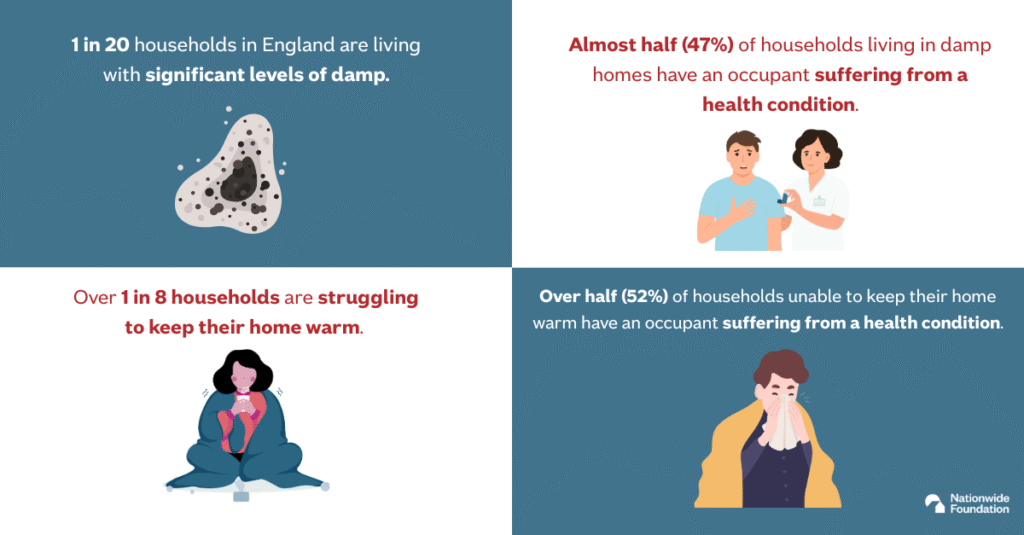
The data within the survey highlights a harsh truth – our homes risk making us ill. The most significant issues are related to:
Dampness
- 1 in 20 households in England (around 1.3 million households) are living with significant levels of damp.
- Almost half (47%) of households living in damp homes have an occupant suffering from a health condition, a 13% increase over 10 years.
Cold homes
- Over 1 in 7 households (around 3.2 million) are struggling to keep their home warm.
- Over half (52%) of these households have an occupant suffering from a health condition, again a 13% increase over the past 10 years.
Overcrowding
Households are said to be overcrowded if they have fewer bedrooms available than the bedroom standard would recommend. Bedroom standard is a guideline that considers the number of people, their ages, sex, relationships (like couples or children), and sometimes disabilities.
- Over 800,000 households in England are overcrowded and over half of those households have at least one person with a health condition.
Category 1 hazards
The survey also reviews the range of hazard categories in the home.
A Category 1 hazard is one that poses a serious and immediate risk to a person’s health and safety, for example, structural collapse, collapsing roofs, asbestos and severe dampness and mould growth.
- Unlike any of the other health-related issues the English Housing Survey explored, it was found that Category 1 hazards have been slowly decreasing over the last 10 years.
- However, there are still 1.9 million households in England with a Category 1 hazard, with more than 760,000 of those homes having at least one occupant with a health condition. Highlighting that there is still a long way to go before all homes are safe.
Children affected by poor housing conditions
Homes should provide a safe and comfortable environment for children to grow. However, the survey found that around 578,000 households with dependent children are living in homes that failed to meet the statutory minimum standard for housing in England. Of those, over 1 in 5 (22%) households have at least one child with a health condition.
There are around 534,000 households with dependent children living in damp homes and around 1.1 million that say they are not able to keep warm during the winter months. There was a higher prevalence of households in the social rented sector (34%) where a child had a health condition, compared with the private sector (17%).
What action are we taking?
Nationwide Foundation believes all people should have access to an affordable and decent home and no one should suffer ill health due to poor housing conditions.
This is why we are champions of the Town and Country Planning Association’s Healthy Homes Principles and have been calling for stronger legislation around the quality of homes, and better standards across two key areas:
New homes
While engaging with the Planning and Infrastructure Bill, we are asking the government to prioritise not just the quantity of new homes delivered, but the quality. We are asking them to deliver all new homes, particularly social homes, in line with the Healthy Homes Principles.
Private Rented Sector
The English Housing Survey found that just under half of all damp private rented homes contained at least one member with a health condition (49%) compared with around a third of homes without damp (34%). Similarly, when it comes to homes that are difficult to heat, almost half (48%) of private rented homes had a member who struggled with a health condition, compared to around a third (32%) of those who live in warm homes.
As members (and funder) of the Renters Reform Coalition, we have advocated for the new Renters’ Rights Bill that will be passed by Parliament in the coming months. Amongst other measures, the Bill will create a Decent Homes Standard, setting a minimum standard for homes to meet before they can be rented out, and extending Awaab’s Law to the PRS, mandating that landlords investigate and rectify health and safety issues within specific time frames.
Without a decent and safe home, you can’t build the foundations to work, study and build a life. A safe, quality home shouldn’t be a luxury, it’s a necessity for a happy and healthy life.
